By Martin Harris.
Dust Collector CFM Chart by Tool
Most stationary woodworking tools need 350 to 600 CFM at the machine. Table saws, jointers, and bandsaws sit near 400 CFM. Drum sanders, big planers, miter saws with a hood, and CNC routers sit at the top of the range. The chart below gives the minimum and recommended number for each common tool, and the rest of this page shows how to turn those numbers into a collector size and a duct size.
CFM stands for cubic feet per minute. It is the amount of air your collector moves. The numbers in this chart are the airflow you need at the tool, after the air has already passed through your hose, duct, and fittings. That is a smaller number than the one printed on the collector's box. Mixing up those two numbers is the most common reason people buy a collector that is too small. If you want the short version, my dust collector size calculator picks a number for you from the same data.
The CFM chart
| Tool | Minimum CFM | Recommended CFM | Typical port |
|---|---|---|---|
| Table saw (cabinet) | 350 | 400 | 4 in. |
| Contractor table saw | 350 | 400 to 450 | 4 in. |
| Cabinet saw with overarm guard | 400 | 550 to 600 | 4 in. + 2.5 in. |
| Jointer (6 or 8 in.) | 350 | 400 to 450 | 4 in. |
| Planer (12 in.) | 400 | 450 | 4 in. |
| Planer (15 in. or larger) | 450 | 550 | 4 to 5 in. |
| Bandsaw | 350 | 400 | 4 in. |
| Router table | 300 | 350 | 2.5 to 4 in. |
| Disc or belt sander | 350 | 400 | 4 in. |
| Small benchtop sander | 300 | 350 | 2.5 to 4 in. |
| Drum sander | 550 | 600+ | 4 in. |
| Lathe | 350 | 400 to 500 | 4 in. |
| Miter saw | 350 | 550+ | 4 in. + hood |
| CNC router | 400 | 550 to 650 | 4 in. |
| Drill press | 300 | 350 | 2.5 to 4 in. |
| Scroll saw | 150 | 250 | 2.5 in. |
| Downdraft table | 400 | 600+ | 4 to 6 in. |
Source: WorkshopCalc dust collector CFM requirements chart. Figures are airflow needed at the tool. A collector's rated CFM will be higher.
Minimum or recommended: which column to use
I read the minimum column as the airflow that gets most of the visible chips into the hose. I read the recommended column as the target when you also care about the fine dust you can't see. I size for the recommended number.
Other sources back up that range. Oneida says most woodworking equipment falls between 250 and 1,000 CFM, and that many common table saws, planers, and jointers need about 300 to 600 CFM. Bill Pentz, the retired engineer whose research site many woodworkers treat as the reference on this subject, takes a stricter view. He uses about 350 CFM as a chip collection number and about 1,000 CFM at many stationary tools when the goal is catching fine dust.
Those numbers answer different questions. A shop where the chips vanish can still have fine dust in the air. Fine dust is the part that matters for your lungs, and my page on whether sawdust is dangerous covers why. If you have a small collector, the recommended column is a practical middle ground. If you are building a new system with room in the budget, sizing toward the Pentz number gives you more margin.
How to use the chart in four steps
- List every tool you want to hook up. Write the recommended CFM next to each one. Include the ports you plan to add later, like an overarm guard on the table saw.
- Circle the single highest number. With blast gates, only one branch is open at a time, so the whole collector works for one machine. You size for the hungriest tool. You do not add the tools together. The exception is two machines you run at the same time, or one machine with two ports. A cabinet saw with an overarm guard counts as one tool at 550 to 600 CFM because both ports are open together.
- Figure out what your duct run costs. Every foot of hose and every elbow adds resistance, called static pressure. The collector has to deliver your target CFM while fighting that resistance. My guide to dust collector static pressure explains the idea, and my static pressure loss calculation walks through the math.
- Compare your target to delivered CFM. Woodcraft's article on dust collection for a one man shop shows the gap. A 1 HP collector rated at 650 CFM moved about 420 CFM through 6 feet of 4 inch flex hose, and less than 300 CFM through a 25 foot run. Several 1.5 HP collectors rated around 1,200 CFM moved roughly 470 to 500 CFM through similar hose.
Matching duct size to the CFM you need
Once you know your CFM, the next question is pipe size. Two numbers tie them together. FPM means feet per minute, which is how fast the air moves. The formula is simple: CFM equals FPM times the inside area of the duct in square feet. Air has to move fast enough to keep dust floating. OSHA's woodworking guidance gives about 2,500 to 4,000 FPM as the range for moving sawdust and chips. Spiral Manufacturing, which makes industrial duct, designs wood dust systems at 4,500 FPM in branches and 4,000 FPM in mains.
| Duct diameter | CFM at 3,500 FPM | CFM at 4,000 FPM | CFM at 4,500 FPM |
|---|---|---|---|
| 4 in. | 305 | 348 | 392 |
| 5 in. | 477 | 546 | 614 |
| 6 in. | 686 | 784 | 882 |
| 7 in. | 935 | 1,068 | 1,202 |
Source: Spiral Manufacturing, CFM for pipe diameter at specified velocity.
Read the chart and this table together. A table saw at 400 CFM moves through a 4 inch duct at about 4,580 FPM, which lines up with Spiral's branch speed. A drum sander at 600 CFM is a different story. Pushing 600 CFM through a 4 inch port means almost 6,900 FPM, and resistance climbs fast as air speeds up. That tool wants a 5 or 6 inch branch that steps down to the port at the very end.
Bigger is not automatically better, though. If you run 400 CFM through a 6 inch pipe, the air slows to about 2,040 FPM, below OSHA's range, and dust can settle in the duct. Oneida makes a related point: a tool's port size is often set by packaging, and the right duct size can be larger. My comparison of 4 inch vs 6 inch dust collection duct goes deeper on picking a size.
Notes on each tool
- Table saw. A cabinet saw has a closed base, so the port under the blade can pull from a sealed box. That is why 400 CFM works. The dust that escapes comes off the top of the blade, which is what an overarm guard with its own 2.5 inch port catches. See my table saw dust collection guide for setups.
- Planer and jointer. These make the largest volume of chips in most shops. A 12 inch planer is at 450 CFM, and a 15 inch or larger planer is at 550. Oneida's duct sizing example uses about 800 CFM for a planer. My planer and jointer dust collection page covers clogs and chip bins.
- Bandsaw. 400 CFM recommended. Most of the dust falls below the table, so the lower port does most of the work.
- Router table. 350 CFM recommended, with ports from 2.5 to 4 inches. Small ports favor a machine that makes high static pressure, which is why some people run a router table from a shop vac. My comparison of dust collectors vs shop vacs explains the tradeoff.
- Sanders. A disc or belt sander needs about 400 CFM, and a small benchtop sander about 350. Sanding makes the finest dust in the shop, so capture at the source matters more here than chip volume.
- Drum sander. The top of the chart at 550 minimum and 600+ recommended. The fine dust load is heavy, so this is the tool that most often shows a small collector's limits. See my drum sander dust collection page.
- Lathe. 400 to 500 CFM recommended. A lathe has no enclosure, so the hood shape and how close it sits to the work count for as much as the CFM number.
- Miter saw. 550+ CFM, and the chart says the 4 inch port needs a hood. The blade is open on top, so a stock port by itself catches only part of the spray.
- CNC router. 550 to 650 CFM recommended. The spindle moves around the whole table, so the dust shoe at the bit does most of the capture. My CNC dust collection guide covers shoes and hose routing.
Why no chart gives you one exact number
A CFM chart is a planning tool. Your real need moves up or down with a few things the chart can't see:
- Hood and port design. A well sealed cabinet needs less air than an open blade or a spinning bowl on a lathe.
- Duct length and fittings. Long runs and tight elbows cut the CFM that reaches the tool.
- Filter condition. A dirty filter adds resistance every week you skip cleaning it.
- Your goal. Clearing chips takes less air than catching fine dust, as the gap between the chart and the Pentz number shows.
When a tool falls between two collector sizes, I pick the bigger collector. A little extra airflow costs a bit more up front. Too little airflow means fine dust in the room no matter how you tune the duct. For how the chart fits into a full shop plan, including collector type, filters, and air cleaning, read my complete guide to small shop dust collection. If you are deciding between collector sizes, my 1 HP vs 2 HP dust collector comparison uses these same numbers.
Collectors matched to the chart
The numbers above tell you what you need. These cover the three brackets most small shops land in.
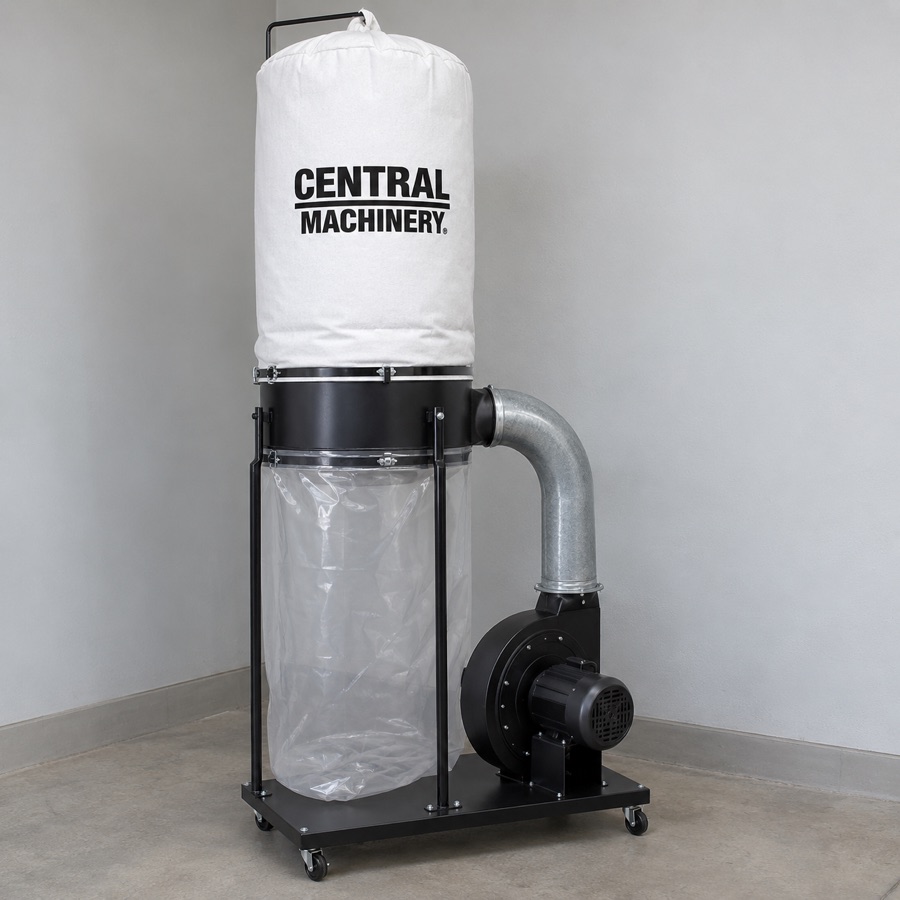 Check price on Harbor Freight
Harbor Freight 2 HP, stock bag$300
For the lower end of the chart, with the caveat that the stock filter is the weak point.
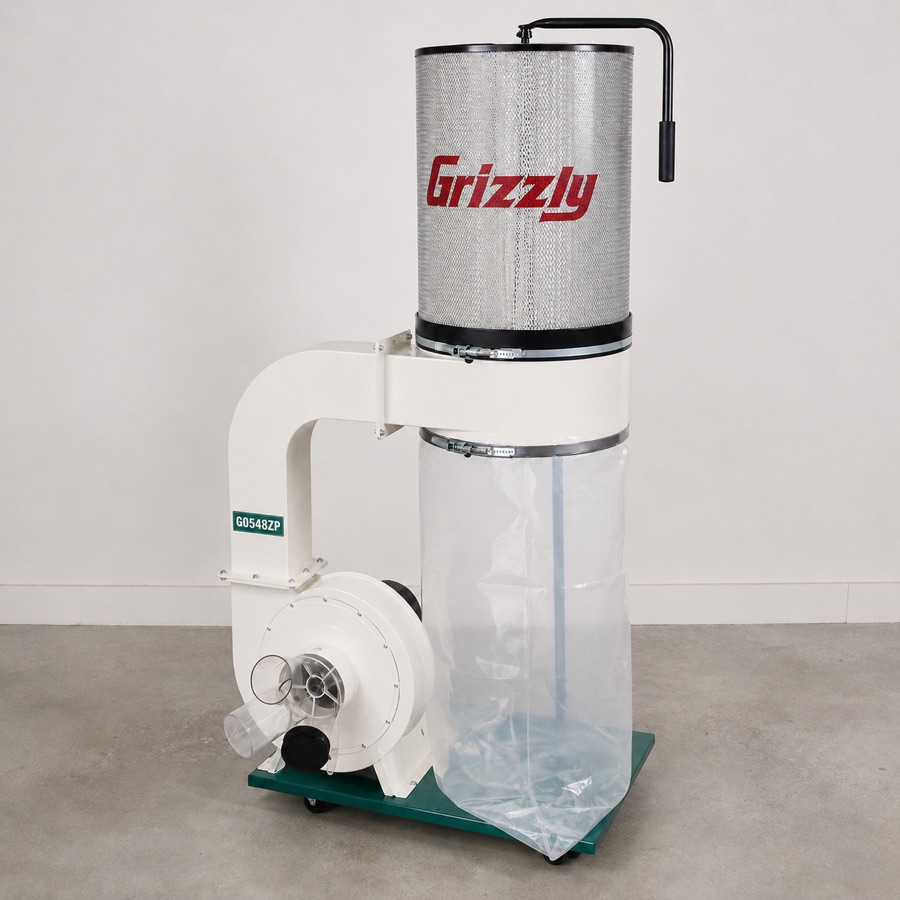 Check price on Grizzly
Grizzly G0548ZP 2 HP canister$755
For the middle, where most one or two machine shops sit.
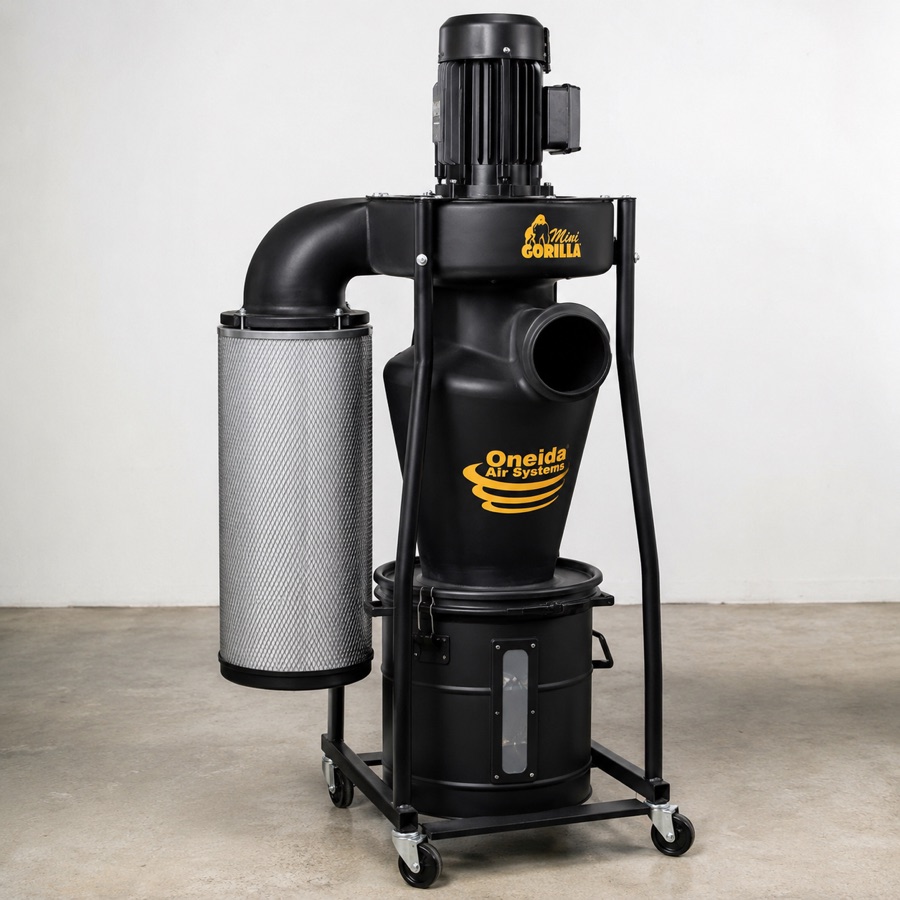 Check price on Oneida Air Systems
Oneida 1.5 HP two-stage cyclone$1999
For the top, where a planer or a drum sander sets the requirement.
FAQ
How many CFM do I need for a table saw?
WorkshopCalc lists 350 CFM as the minimum and 400 CFM as the recommended figure for a cabinet saw with a 4 inch port. A contractor saw is 400 to 450. If you add an overarm blade guard with its own port, plan for 550 to 600 CFM with both ports open.
Do I add up the CFM for all my tools?
Only if you run them at the same time. With a blast gate on each branch and one gate open, you size for your single biggest tool. Adding every tool together gives you a much larger collector than you need.
Is a 650 CFM dust collector enough for a small shop?
It depends on what 650 means. Woodcraft measured a 1 HP collector rated at 650 CFM at about 420 CFM through 6 feet of 4 inch flex hose. That covers tools in the 350 to 400 CFM range on a short hose. It falls short for a drum sander, a large planer, or a long duct run.
How much CFM do I need to catch fine dust?
More than the chart's minimums. Bill Pentz uses about 1,000 CFM at many stationary tools as his fine dust target. The recommended column in the chart above is a middle ground that most small shop collectors can reach.