By Martin Harris.
How to Build a Thien Baffle (Plans and Measurements)
A Thien baffle is a flat disc with a curved slot along most of its edge. It hangs a few inches below the lid of a trash can, drum, or bucket. Air comes in along the wall, spins above the disc, and chips and dust drop through the slot into the can. In Phil Thien's original shop vac version, the slot is 1-1/8 in. wide, it runs 240 degrees around the disc, and the disc sits about 3 in. below the rim.
Phil Thien is a woodworker who developed the design over about two years and nearly 50 versions, then posted the details on his site, jpthien.com. Every dimension on this page comes from one of three places: Thien's own write-up, plans posted on Thien's discussion forum by a builder who goes by dbhost, or a Thien separator design sheet by a reader named Hector that Matthias Wandel hosts on woodgears.ca. I name which is which as I go.
How the baffle works
A plain cyclone lid spins air inside the can, and that spinning air keeps hitting the dust already sitting in the bottom. Thien called this scrubbing: the air picks settled dust back up and carries it on to the vac. He tested three store-bought cyclone lids, found big chips getting through to his vac, and saw each one get worse once the can passed about a quarter full.
The baffle splits the can into two spaces. The top space, between the lid and the disc, is where the air spins. The bottom space holds the dust, out of the path of the fast air. Thien lists three effects. The disc keeps turbulence off the settled pile. Any dust that does get stirred up has to come back through the slot and spin again before it can reach the outlet, and dust heavy enough to settle once will likely settle again. And you can fill the can to within 3 in. of the top, which is the bottom of the baffle, without losing separation.
Hector's design sheet adds two points to keep in mind before you cut anything. The slot width is the one fixed dimension, and the rest of the design scales to your container. And a smooth inside with airtight construction improves operation a great deal.
Key dimensions
| Dimension | Value | Source |
|---|---|---|
| Drop slot width | 1-1/8 in. for a shop vac build; 1-1/4 in. planned for a 55 gallon drum with 4 in. ports | Thien; dbhost |
| Slot length | 240 degrees of the circle | Thien |
| Solid section | 120 degrees left at full diameter | Thien |
| Baffle full diameter | Inside diameter of the can, measured about 3 in. down from the rim | Thien |
| Baffle trimmed diameter | Full diameter minus 2.25 in., along the 240 degree slot section | Thien |
| Baffle depth below lid | About 3 in. with 2.5 in. ports; Hector sets it equal to the inlet diameter | Thien; Hector |
| Inlet position | Elbow about 3/4 in. from the can wall, blowing along the wall | Thien |
| Outlet position | Dead center of the lid | Thien; Hector |
| Outlet tube below lid | 1.5 in. on a shop vac unit; 2.5 in. on a 55 gallon collector unit; Hector uses half the inlet diameter | dbhost; Hector |
| Lid disc radius | Half the outside lip diameter, plus 1/4 in. | dbhost |
Sources: J. Phil Thien, cyclone separator lid page at jpthien.com; plans posted by dbhost on the Thien Cyclone Separator Lid discussion forum; Hector's "Thien Separator Design Guidelines" drawing hosted on woodgears.ca.
Hector's sheet also says the direction of spin, clockwise or counterclockwise, does not matter, so you can flip the layout to put the inlet wherever it suits your shop. It says the shape and size of the container do not change how it works. And dbhost reported that he cut a 1-3/8 in. slot by mistake on a baffle for his Harbor Freight 2 HP collector, and it still worked fine. Small errors in the slot are forgiving.
There is no separate gap around the outside of the baffle. The slot is the gap. Along the 240 degree section, the disc is cut smaller, and the space between the disc edge and the can wall forms the drop slot. Along the 120 degree section, the disc reaches the wall. Keep the outer edge of the slot at the can wall itself. If you cut the slot as a hole inside the disc, you leave a ring of wood where dust can pile up.
Choose your container
The can has to seal and hold its shape under suction. This matters most on a shop vac. Oneida Air Systems says a shop vac pulls more than 60 inches of water column, written in. w.c., which is the unit for suction pressure. For its own shop vac cyclones, Oneida says a 5 gallon bucket needs a wall at least 90 mils thick (0.09 in.), and that big box store buckets are too thin. A mil is one thousandth of an inch. The same suction works on a baffle lid, so the same rule applies.
dbhost's plans use galvanized steel trash cans, and he describes a collector version built on a 55 gallon drum. A thick 5 gallon bucket works for a small shop vac build, and two thin buckets nested together hold their shape too. If you plan to use liners, my guide to dust collector bins, buckets, and liners covers liner sizes and thickness.
Materials list
| Item | Purpose | Notes |
|---|---|---|
| Container | Holds the dust | Steel trash can, 55 gallon drum, or a 90 mil 5 gallon bucket |
| 3/4 in. MDF or plywood | Lid top and baffle | dbhost lists MDF, sanded Baltic birch, or poplar plywood |
| 1/8 in. hardboard (optional) | Thinner baffle | Hector's sheet suggests thin material for the baffle |
| Inlet port and 90 degree elbow | Brings air in along the wall | 2.5 in. for a shop vac; for a collector, dbhost uses a 4 in. PVC street elbow or a 4 in. dust collection elbow |
| Outlet port and short tube | Air exit at the center | Thien used a PVC coupler as the tube; dbhost uses a 4 in. pipe nipple or hose splice |
| 1/2 in. ABS pipe | Spacers between lid and baffle | Thien cut it to length and tapped it for 1/4 in. machine screws |
| 1/4 in. machine screws | Hold the baffle to the spacers | Length to suit your spacer height |
| Foam weatherstrip or rubber gasket | Seals the lid to the rim | The goal is an airtight lid |
| Hot melt glue or silicone caulk | Seals fittings to the lid | Thien hot melt glued his PVC fittings to the plywood top |
Sources: J. Phil Thien, jpthien.com; dbhost's plans on the Thien discussion forum; Hector's design sheet on woodgears.ca.
Tools: a jigsaw, or a router with a circle jig; a drill; hole saws sized to your ports; a tape measure; a protractor for the 120 degree layout; and a tap if you thread the spacers the way Thien did.
Step by step build
- Measure the container. For the lid top, dbhost measures across the outside lip in at least 3 spots, averages them, divides by 2 for the radius, and adds 1/4 in. For the baffle, measure the inside diameter of the can at the depth the baffle will sit. For a 2.5 in. port build, that is about 3 in. down from the rim, as Thien did. Cans are often narrower lower down, so measure at that depth.
- Cut the lid disc. Set a circle jig to the lid radius and cut the top from 3/4 in. MDF or plywood.
- Draw the baffle. On a second blank, draw a circle at the inside diameter you measured. From the same center, draw a second circle 2.25 in. smaller in diameter. That is 1-1/8 in. smaller in radius, which is the slot width. For a collector build with a 1-1/4 in. slot, make the second circle 2.5 in. smaller in diameter.
- Mark the solid section. Draw two lines out from the center, 120 degrees apart. Between them, the baffle stays at full diameter. The other 240 degrees get cut down to the smaller circle.
- Cut the baffle. Cut the full circle first, then trim the 240 degree section down to the inner line. Sand the edges smooth, since Hector's sheet says a smooth inside helps.
- Cut the port holes. Cut the outlet hole at the dead center of the lid. Cut the inlet hole near the edge, placed so the elbow ends up about 3/4 in. from the can wall. Aim the elbow so the air blows along the wall, around the can, and away from the center.
- Line up the inlet with the solid section. Thien photographed where his elbow sits relative to the 120 degree solid section, and wrote that testing showed this layout minimized turbulence. Hector's drawing makes the layout clear. The air enters over the solid part of the baffle, and the drop slot starts past the inlet, in the direction the air travels. So incoming air is already spinning along the wall by the time it reaches the slot.
- Install the fittings. Glue or screw the outlet port and the inlet elbow to the lid, and seal around both. dbhost runs his outlet tube 1.5 in. below the lid on his shop vac unit and 2.5 in. below on his 55 gallon collector unit.
- Hang the baffle. Cut spacers from 1/2 in. ABS pipe so the baffle sits about 3 in. below the lid for a 2.5 in. port build. Hector's sheet sets that gap equal to the inlet diameter, so plan on about 4 in. for 4 in. ports. Screw through the baffle into the spacers. dbhost adjusts the spacing until it is even all around and the elbow just touches the baffle.
- Seal the lid. Add foam weatherstrip or a rubber gasket where the lid meets the rim. A leak at the lid pulls in outside air that skips the spin.
- Test it. Connect the vac or collector to the outlet and a tool hose to the inlet. Run a scoop of shavings and sanding dust through it, then open the vac or collector and look at the filter. The Wood Whisperer used this kind of filter check in his cyclone separator shootout. If a lot of dust reached the filter, check the lid seal first.
Scaling up for a dust collector
Thien wrote that the design scales well. He built units for dust collectors and fitted his baffle to single-stage collectors, which he said keeps the cartridge filters on top cleaner for longer. For a collector, use ports that match your hose, usually 4 in., and a bigger container such as a 55 gallon drum. dbhost planned a 1-1/4 in. slot and a 2.5 in. outlet tube for his 55 gallon, 4 in. build.
A baffle adds resistance, like any separator. My Harbor Freight dust collector review covers the 2 HP collector with a Thien baffle mod, and my data for that setup lists roughly 2 in. w.c. of added system loss. Plan your hose and duct with that loss in mind, and keep flex hose short.
A baffle catches the bulk of the dust, and the filter still does the final cleaning of the air. My Dust Deputy vs Thien baffle comparison shows how much fine dust each type holds back before it reaches the filter.
Common mistakes
- Leaky lid or fittings. Outside air pulled in at a gap bypasses the spin. Seal everything, then listen for hissing with the vac running.
- A thin container. Thin buckets and plastic cans can suck in under shop vac suction. Use a thick bucket, nested buckets, or steel.
- An inlet aimed at the center. The air has to enter along the wall to spin. Keep the elbow about 3/4 in. from the wall and pointed around the can.
- Measuring the can at the rim. Size the baffle to the inside diameter at the depth where it will hang.
- A slot with a ledge. Keep the outer edge of the slot at the can wall, with no ring of wood outside it.
- Overfilling. Thien says you can fill to within 3 in. of the top, which is the bottom of the baffle. Empty it before the pile reaches that point.
Where to go next
To compare this build with a store-bought cyclone kit or a stacked bucket setup, see my three DIY dust separator builds for a shop vac. For every separator I recommend, including ready-made cyclones, see my best dust separator roundup. And for how a separator fits into the rest of a garage system, read my complete guide to small shop dust collection.
If you would rather buy than build
A baffle is a good weekend project. If you would rather not spend the weekend, these do the same job out of the box.
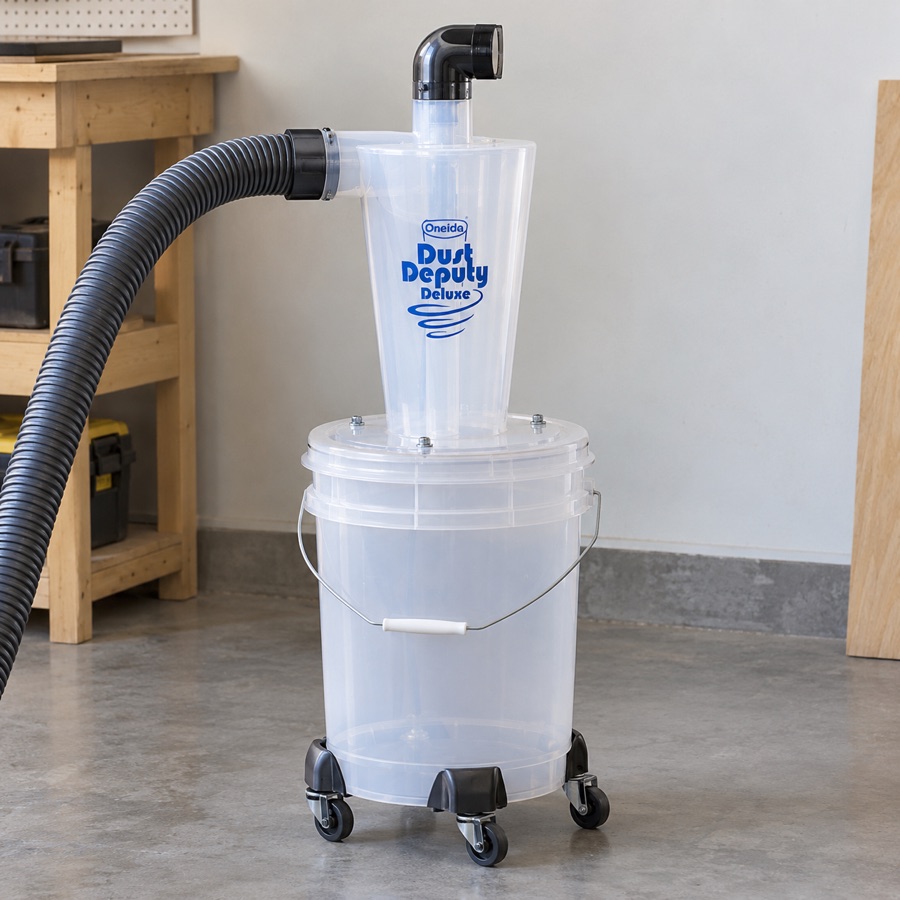 Check price on Amazon
A bought cyclone separates better than most shop built baffles and takes ten minutes to set up.
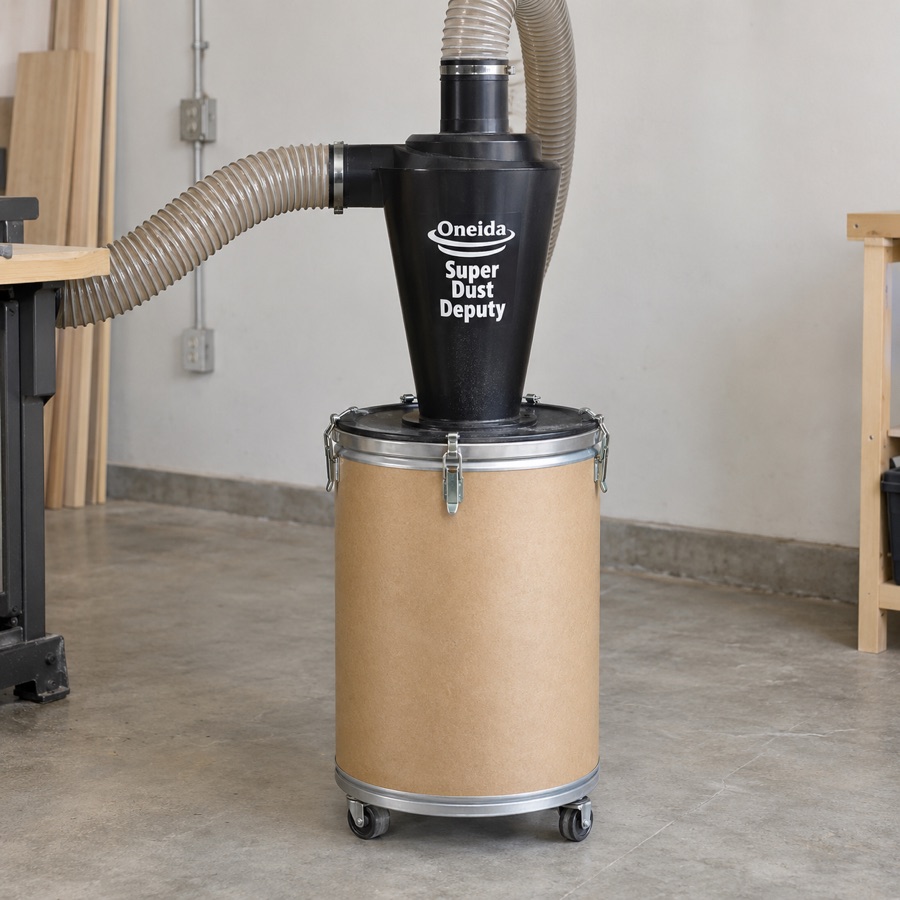 Check price on Amazon
The larger version, sized for a full size collector rather than a shop vac.
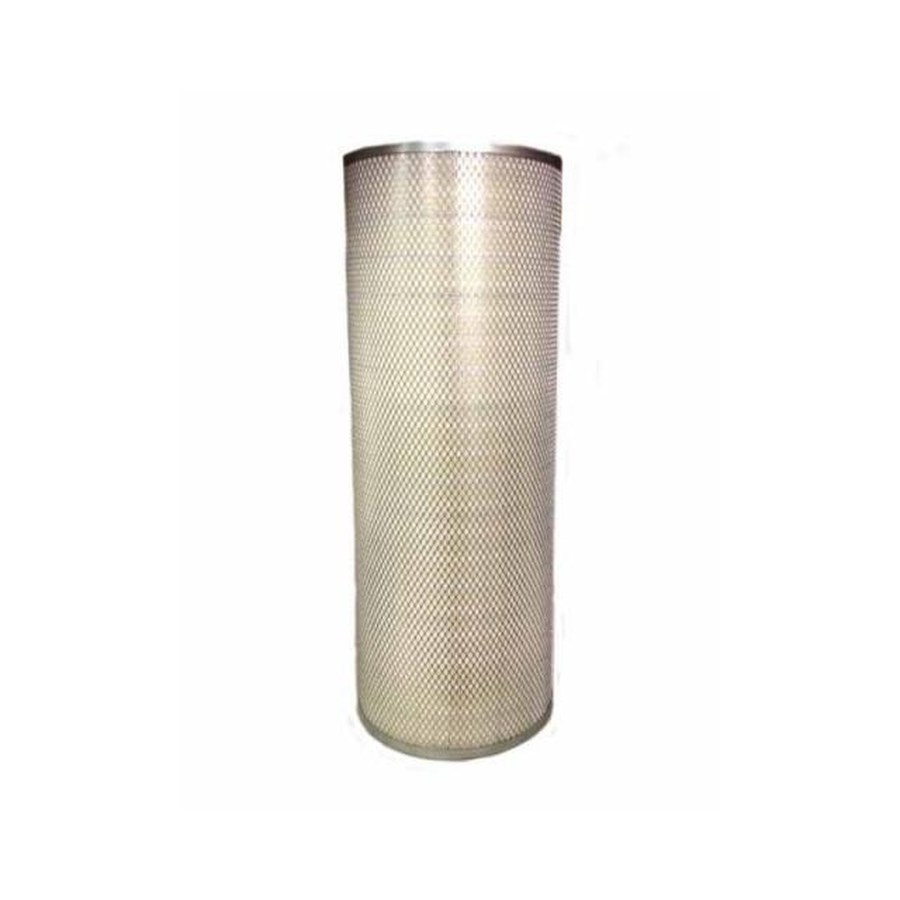 Check price on Amazon
Wynn-style 0.5-micron cartridge$220
Whichever route you take, the separator exists to protect the filter. Worth upgrading that at the same time.
FAQ
How wide should the slot in a Thien baffle be?
Phil Thien's shop vac version uses a 1-1/8 in. drop slot. dbhost, who posted plans on Thien's forum, planned 1-1/4 in. for a 55 gallon drum with 4 in. ports, and reported that a 1-3/8 in. slot he cut by mistake still worked.
How far below the lid does a Thien baffle go?
About 3 in. in Thien's shop vac build with 2.5 in. ports. Hector's design sheet sets the gap equal to the inlet diameter, so bigger ports call for a deeper baffle.
Does it matter which way the air spins?
No. Hector's design sheet says clockwise or counterclockwise rotation does not matter, and the layout can be flipped. What matters is that air enters along the wall and passes over the solid section before it reaches the slot.
Can I build a Thien baffle in a 5 gallon bucket?
Yes, as long as the bucket holds its shape under shop vac suction. Oneida says buckets for its shop vac cyclones need at least a 90 mil wall, or you can nest two thin buckets together.
Is a Thien baffle as good as a cyclone?
It does a lot of work on bulk chips for very little money. A true cyclone holds back more of the fine dust. My Dust Deputy vs Thien baffle page compares the two on fine dust, cost, space, and airflow.